A person’s experience of recovering from laser resurfacing and an investigator’s measurement of that recovery answer different questions. Both matter, but neither substitutes for the other. Copper-peptide research makes this distinction especially important: a favorable questionnaire result is not automatically evidence of faster wound repair, while an inconclusive measurement does not establish that participants experienced no benefit.
This analysis uses the indexed primary report abstracts for the laser and laboratory studies, alongside an author-posted full-text OCR of a diabetic-ulcer trial. It separates direct observations from methodological interpretation. The central question is not whether copper peptides deserve a universally positive or negative label. It is which claims each experiment actually tested—and what additional evidence would connect a biological signal, a patient rating, and a clinically meaningful change.
Download chart data (CSV)Download chart (PNG)
Study facts at a glance
Laser-study size: Thirteen participants completed the study; enrollment, randomized arm sizes, and attrition are unreported in the abstract. [1]
Study setting: The intervention was topical postprocedure care following CO2 laser resurfacing around the mouth, not routine treatment of intact facial skin. [1]
Different kinds of endpoints: Patient questionnaires, blinded appearance assessments, and wound-area measurements should not be treated as interchangeable evidence. [1] [2]
Ulcer-trial denominator: The ulcer study enrolled 181 people overall; that total is not the denominator for its immediate-treatment plantar-ulcer comparison. [2]
Laboratory boundary: Fibroblast experiments investigate cellular responses, not whether a finished facial product reaches its target or improves a person’s skin. [3] [4]
Related reading: What copper peptides can—and cannot—tell you · CoreAge Rx Bounce Back review
The comparison was aftercare added to a shared procedure
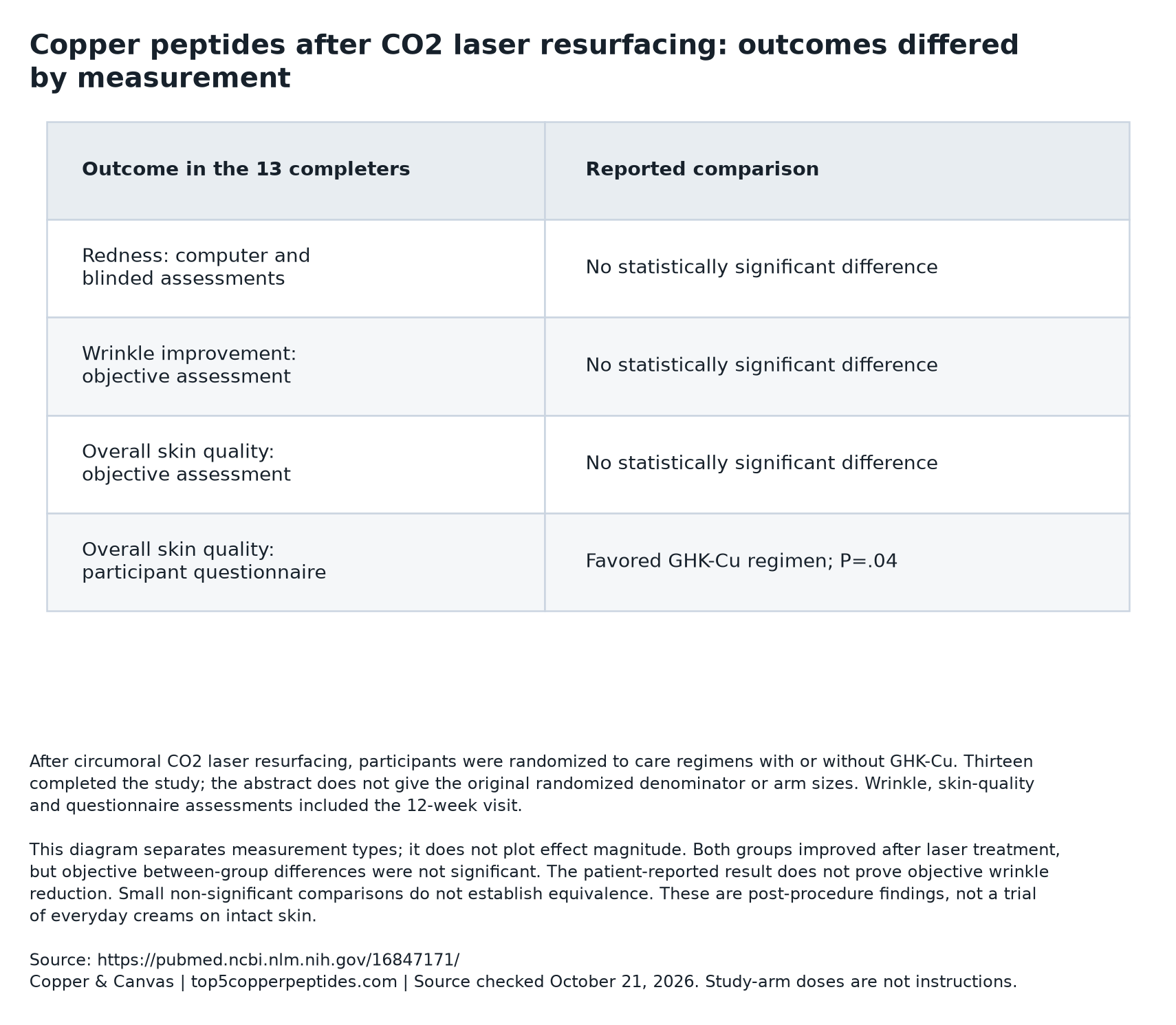
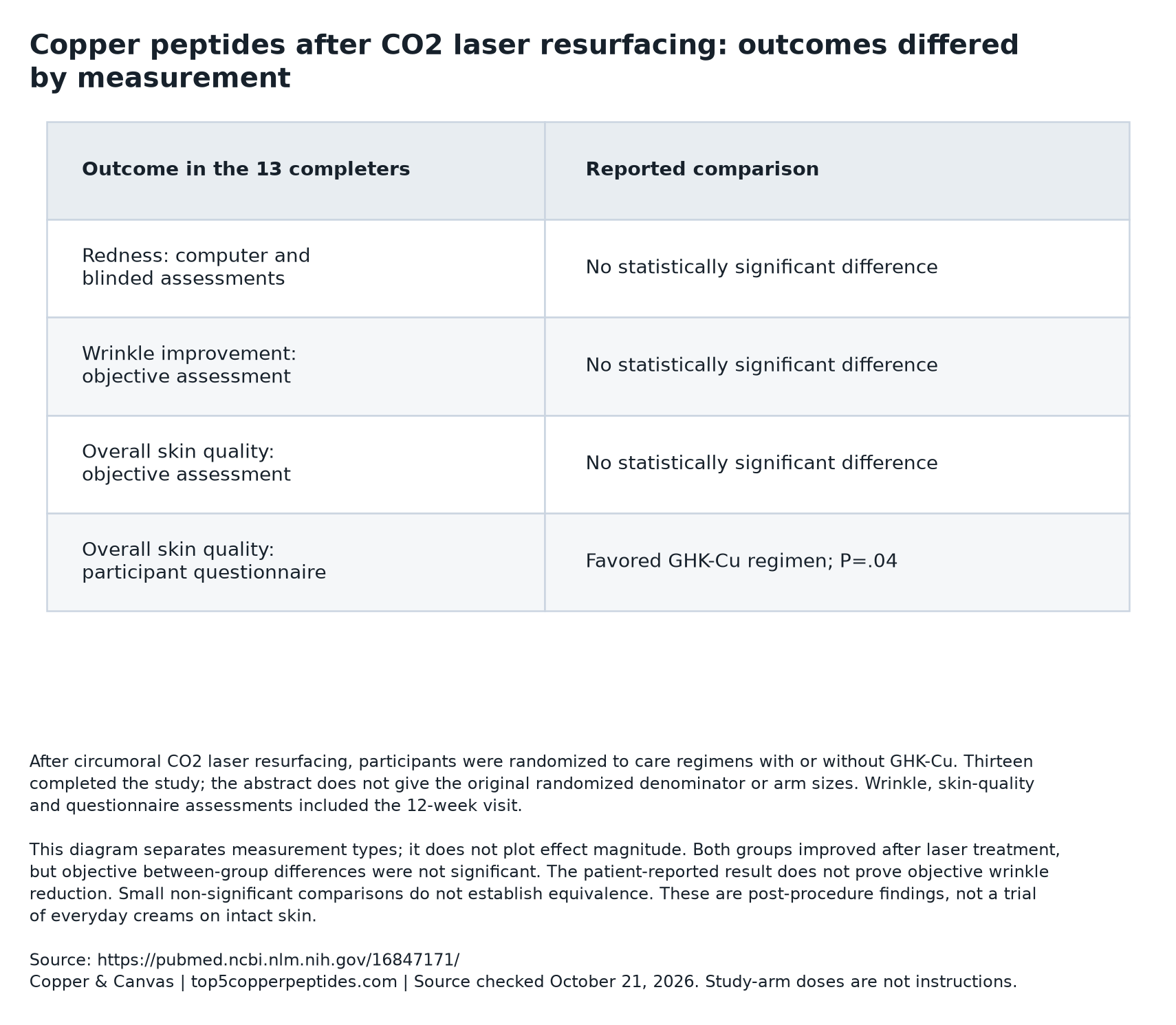
Participants were randomized to regimens with or without GHK-Cu after circumoral CO2 resurfacing. Computer analysis and blinded evaluators assessed erythema, or redness; wrinkles and overall appearance were evaluated at 12 weeks. No significant between-group advantage emerged on those measures, although both groups improved after resurfacing.
The methodological point is that the treatment contrast concerns the added regimen, not the entire recovery package. When everyone receives the same major procedure, improvement from baseline cannot by itself identify an extra ingredient’s contribution. The relevant calculation is the difference between groups’ changes, with uncertainty around that difference. Otherwise, the procedure’s effects can be mistakenly credited to aftercare.
As an illustrative example, suppose two groups improve by eight and seven units on an appearance scale. Those are substantial within-group changes, but the incremental contrast is one unit. Whether that contrast is meaningful depends on the scale, its measurement error, and its confidence interval. These are invented numbers, not trial results. This distinction is also central to reading ingredient evidence: improvement during use is not necessarily improvement caused by the ingredient.
A questionnaire result measures experience, not redness
A validated questionnaire favored GHK-Cu for posttreatment overall skin-quality improvement, with P = .04. That subjective result deserves attention on its own terms. It does not reverse the objective comparisons or reveal which aspect of the regimen produced the reported experience.
A questionnaire can capture aspects of experience that an image-based assessment does not ask about. Conversely, a photographic score may detect a change that does not matter much to the participant. These are general measurement possibilities, not documented explanations for this trial. Without detailed questionnaire results, one cannot determine whether the favorable rating reflected a particular sensation, appearance judgment, or broader impression of recovery.
Interpretation therefore requires matching the claim to the instrument. A patient-centered benefit need not be dismissed because it is subjective. It does, however, need a magnitude, a clear question, and enough detail to judge relevance. A broad statement such as “better healing” collapses several distinct outcomes into one unsupported conclusion. The more useful question is what the participant reported, over what interval, and by how much.
| Endpoint type | Question it addresses | Inference it does not supply alone |
|---|---|---|
| Patient questionnaire | How participants rate a defined experience or change | A measured reduction in redness or wound area |
| Blinded appearance assessment | Whether an evaluator detects a visible difference | How meaningful recovery feels to the participant |
| Wound-area measurement | How the open wound’s dimensions change | A facial antiwrinkle effect or better satisfaction |
Compare the options in top 5 copper peptide creams & serums or read Bounce Back versus The Ordinary copper peptides.
Statistical significance does not describe the size of a benefit
The laser abstract provides no effect size or confidence interval. That omission limits interpretation in two directions: the favorable questionnaire finding cannot be translated into a practical amount of benefit, and the nonsignificant comparisons cannot establish equivalence.
A P value describes how compatible the observed data are with a specified statistical model under a null hypothesis. It is not the probability that the product works, nor a measure of how noticeable a change would be. Two studies can produce similar P values while describing very different magnitudes of improvement. Precision also matters: an estimate with a narrow interval supports a more specific conclusion than one compatible with a wide range of effects.
Equivalence requires a different question and design: can clinically important differences be excluded within prespecified bounds? Failure to detect a difference does not answer that question. For a small study, a useful reading is that the objective advantage was not demonstrated, rather than that an advantage was definitively disproved. Our copper-peptide overview uses the same distinction between evidence that is absent, inconclusive, and directly unfavorable.
Completers are not a substitute for participant flow
A completer count describes who reached a specified study milestone. It does not establish the initial denominator, the balance between groups, or the reasons for missing observations. Those details are needed to understand how closely the analyzed participants represent the people originally assigned treatment.
Consider an illustrative study in which people with disappointing recovery are less likely to return. An analysis restricted to returnees might look more favorable than an analysis retaining everyone as assigned. The reverse could occur if satisfied participants stop attending. Neither scenario is documented here; they explain why participant-flow reporting matters. Missingness is potentially informative because the reason data disappear may relate to the outcome being measured.
Randomization and blinded evaluation address separate problems. Randomization aims to balance competing explanations at assignment; evaluator blinding limits the influence of knowing treatment on scoring. Neither automatically resolves later missing data or guarantees precise estimates. A stronger report would connect assignment, follow-up, exclusions, and each endpoint’s analysis population. Readers should not reconstruct that flow from the final count or assume equal arm sizes merely because allocation was randomized.
Collagen production and matrix remodeling are different questions
In fibroblast cultures, one experiment found increased collagen synthesis without a change in cell number. Another found increased MMP-2 expression and secretion of TIMP-1 and TIMP-2. Copper ions reproduced the MMP-2 response, whereas GHK alone did not. These observations concern cells under experimental exposure, not visible changes in patients.
Fibroblasts help build and maintain connective tissue. MMPs are enzymes involved in breaking down extracellular matrix, the material surrounding cells; TIMPs inhibit metalloproteinases. Studying enzymes and inhibitors together is important because tissue repair is not simply a contest to accumulate the most collagen. Production, removal, organization, and timing can all matter. A change in one laboratory marker cannot summarize that coordinated process.
The translational question is whether an appropriate exposure reaches relevant cells in living tissue and produces a useful net effect. Culture dishes bypass important delivery barriers and do not reproduce an entire wound environment. Mechanistic plausibility can justify a clinical experiment, but it cannot supply the experiment’s result. The comparison of copper and other peptides provides a useful framework for keeping ingredient identity separate from evidence about a finished formulation.
The ulcer trial tested an adjunct to structured wound care
The randomized, evaluator-blinded ulcer study compared topical GHK-Cu gel with vehicle alongside standardized wound care, including debridement and pressure-relieving footwear. Immediate treatment used 2% gel for up to eight weeks, followed by six weeks of observation. A separate delayed component used four weeks of vehicle before eight additional weeks of vehicle, 2%, or 4% gel.
These are historical study exposures, not treatment instructions. Scientifically, the shared care program defines the background against which an added effect was tested. A vehicle comparison is more informative than comparing treated wounds with no care, because it helps separate the active formulation’s contribution from the application process and gel base. It does not remove the importance of the surrounding clinical program.
The contrast with laser aftercare is therefore substantive, not merely a difference in sample size. Chronic neuropathic ulcers and newly resurfaced facial skin present different clinical questions, starting conditions, and endpoints. Our companion analysis of the diabetic-ulcer study examines that wound setting in greater depth. One study cannot serve as a larger replication of the other simply because both involve a copper-peptide complex.
| Evidence setting | Experimental contrast | Main interpretive boundary |
|---|---|---|
| Laser aftercare | Postprocedure regimens with versus without GHK-Cu | An adjunct after resurfacing is not routine intact-skin care |
| Neuropathic ulcers | Topical gel versus vehicle within structured wound care | Ulcer closure is not a wrinkle endpoint |
| Fibroblast cultures | Cellular responses to experimental exposure | Biological activity does not establish clinical delivery or benefit |
Wound-area percentages require a denominator and a time definition
The ulcer report gives median area closure of 98.5% versus 60.8% for the immediate-treatment plantar comparison. These are not percentages of participants healed. The endpoint used each participant’s last visit, rather than a uniform 14-week observation for everyone. Longitudinal graphs carried the last available value forward.
The reported medians differ by 37.7 percentage points. That subtraction describes the distance between two group summaries; it is not an individual treatment effect or a healing probability. For illustration, a wound shrinking from 100 square millimeters to 20 has 80% area closure. If it instead expands to 120, closure is negative 20%. Improvement is capped at complete closure, while worsening can extend far below zero, making means and medians behave differently.
Time handling adds another layer. Carrying an observation forward assumes that the recorded state can stand in for an unobserved later state. A wound could instead improve or worsen after follow-up ends. Including everyone in an analysis is valuable, but does not eliminate that assumption. The confidence placed in a last-visit result therefore depends partly on why visits ended and whether conclusions remain stable under alternative missing-data assumptions.
Timing findings raise hypotheses without settling the mechanism
The delayed ulcer-treatment groups did not show a significant improvement over vehicle. In the separate immediate-treatment plantar-ulcer comparison, the full report describes a mean normalized linear edge-advance rate more than threefold that of vehicle, measured in millimeters per day. That is not a claim that three times as many people healed. Closure speed, amount of closure, and the proportion reaching a threshold are separate outcomes.
Timing comparisons can suggest that the state of a wound matters, but they do not independently identify the biological reason. Possible explanations would require measurements of exposure, tissue condition, or the relevant repair processes. A clinical pattern alone cannot distinguish improved access to tissue from a change in the tissue’s responsiveness. The distinction matters because each explanation would generate different predictions for a future experiment.
A useful follow-up design would prespecify how timing is compared, use consistent outcome windows, and measure plausible intermediate steps without mistaking them for final outcomes. It would also distinguish a treatment-by-timing interaction from separate significance tests: one comparison being significant and another nonsignificant does not itself prove their effects differ. These are methodological requirements, not a claim that an unreported analysis was performed. They keep the observed pattern from becoming a prematurely settled mechanism.
Safety reporting needs both local and overall outcomes
The ulcer abstract reports infection incidence of 7% versus 34%, restricted to plantar ulcers treated immediately after debridement. The full-text narrative reports no significant overall adverse-event-rate difference. Those statements concern different safety summaries and should not be merged into a blanket claim of safety.
An infection outcome is clinically important, but it does not describe every possible adverse effect. Likewise, a nonsignificant overall comparison does not show that event rates were identical or that uncommon harms were excluded. For safety interpretation, the needed information includes event definitions, severity, timing, exposure duration, and what happened after an event. A favorable local finding can coexist with uncertainty about other outcomes.
The laser abstract supplies no adverse-event counts, concentration, or funding statement. The ulcer paper documents ProCyte affiliations and acknowledges its development team, establishing commercial involvement without establishing a specific funding arrangement. Transparency about these gaps is more useful than inferring either sponsorship or independence. For documentary checks rather than trial-outcome claims, readers can consult the Empower Pharmacy review and CoreAge Rx review; neither link transfers these study findings to a provider.
A finished product needs its own bridge to the clinical evidence
Translation to everyday skincare requires more than matching an ingredient name. A meaningful bridge would connect the tested formulation, route, tissue condition, exposure, comparator, and outcome to the proposed use. Changing several of those variables creates a new question rather than a minor extension of the original one.
Concentration illustrates the problem. A label percentage does not by itself establish the amount reaching target cells, and a culture concentration is not a facial-product dose. Formulation and application context must be considered before numbers become comparable. The guide to copper-peptide percentages explains why a larger printed number is not a clinical ranking. Neither a wound gel nor postlaser care automatically validates a retail cream, compounded preparation, oral formulation, or systemic injection.
Editorial interpretation: purchase and care decisions should separate documentary certainty from biological uncertainty. Ingredients, quantity, return provisions, and contract terms may be checkable even when efficacy remains unresolved. None of these experiments estimates consumer value or compares subscription arrangements. A future intact-skin trial would need an appropriate formulation control, prespecified visible and patient-reported outcomes, adequate follow-up, and transparent safety reporting before a product-specific cosmetic conclusion became defensible.
What this evidence supports
The strongest reading preserves three separate propositions: patients can report a favorable experience, investigators can fail to demonstrate an objective advantage, and laboratory experiments can support a plausible research direction. These propositions need not conflict. What remains unresolved is the magnitude and reproducibility of the patient-centered benefit, the precision of the objective comparisons, and the relevance to other formulations or intact skin. The ulcer evidence adds a distinct clinical wound context, not a shortcut to facial efficacy. Copper & Canvas’s assessment is to match every claim to its endpoint and setting, rather than force all observations into a single verdict on the ingredient.
Research access and limitations
Laser and cell-study analysis is abstract-based. Ulcer analysis additionally uses author-posted primary full-text OCR; original table and figure layouts were not verified, so ambiguous arm counts and categorical rates are excluded. This is not a review of all protocols, supplements, or full texts. Unreported estimates, confidence intervals, funding details, and adverse-event counts have not been reconstructed.
Questions about the evidence
Should the patient-reported finding be considered less real than an image score?
No. Experience is a legitimate outcome when measured appropriately. The issue is scope: a rating supports a claim about the reported experience, not an unmeasured biological process. Its practical importance still depends on the size of the difference, what the questionnaire asked, and whether the result is reproducible. [1]
Does a nonsignificant result mean the groups stayed unchanged?
No. A between-group test asks whether outcomes differ across treatments, not whether either group changed over time. Both groups could improve substantially while their difference remains uncertain. Confusing those questions can either overcredit an adjunct or incorrectly suggest that the underlying procedure accomplished nothing. [1]
Why not combine the laser and ulcer results into one conclusion?
Their populations, tissue conditions, treatment packages, and endpoints are not interchangeable. Combining them informally can create an impression of replication without a shared clinical question. They are better used as complementary evidence about where further testing might be worthwhile, rather than as a pooled estimate of cosmetic efficacy. [1] [2]
Would evidence of collagen stimulation establish wrinkle reduction?
Not by itself. A cellular response is an intermediate observation. Demonstrating wrinkle reduction requires a clinical comparison that measures wrinkles, while establishing the proposed mechanism would require additional evidence connecting exposure, tissue response, and visible outcome. Those steps should not be filled in by assumption. [3] [4]
What would make a replication more informative?
A replication should report participant flow, prespecified primary and secondary endpoints, between-group effect sizes with confidence intervals, clinically meaningful thresholds, and detailed adverse events. It should also explain masking and missing-data handling. That would help distinguish an interesting statistical signal from a sufficiently precise and useful benefit. [1] [2]
Sources and verification
Official pages establish product facts and provider claims. Clinical and regulatory sources answer separate evidence questions. Article checked October 21, 2026; individual source dates appear below. No medical reviewer is credited for this article.
- Effects of topical copper tripeptide complex on CO2 laser-resurfaced skin. ↗ · Checked October 21, 2026 · Indexed primary study abstract
- Mulder et al., 1994: GHK-Cu in diabetic neuropathic ulcers (author-posted full text) ↗ · Checked October 21, 2026 · Author-posted primary full-text OCR; original table and figure layout not verified
- Stimulation of collagen synthesis in fibroblast cultures by the tripeptide-copper complex glycyl-L-histidyl-L-lysine-Cu2+. ↗ · Checked October 21, 2026 · Indexed primary laboratory-study abstract
- The tripeptide-copper complex glycyl-L-histidyl-L-lysine-Cu2+ stimulates matrix metalloproteinase-2 expression by fibroblast cultures. ↗ · Checked October 21, 2026 · Indexed primary laboratory-study abstract
- Enhanced healing of ulcers in patients with diabetes by topical treatment with glycyl-l-histidyl-l-lysine copper. ↗ · Checked October 21, 2026 · Indexed primary study abstract